

HARRY'S BI-WEEKLY UPDATE 4.23.26
April 23, 2026
HARRY’S BI-WEEKLY UPDATE
A Current Look at the Colorado Springs Residential real estate Market
As part of my “Special Brand of Customer Service”, it is my desire to share current Residential real estate issues that will help to make you a more successful and profitable Buyer and Seller.

NOT TOO MUCH TO REPORT IN THE WAY OF “NEWS” AS IT’S JUST BEEN MORE OF THE SAME…
In what is the beginning of the “traditional” spring buying and selling season, so far we haven’t seen a lot of either.
Yes, there are those who are selling. And there are those who are buying. But activity up to now has been slower than expected.
Some of that can be attributed to interest rates and some to the fact that, while we still have an inventory shortage despite more available homes for sale, we are now most definitely in a “Buyer’s Market”. That means potential buyers are in charge and they are taking their time with decision making and asking for concessions that were not on the table just several years ago.
Yes, buyers are “looking”, but they can afford to take their time, and I’ve found that often to be the case in recent days.
Homes are staying on the market longer and price reductions, sometimes more than once or twice, are becoming the norm.
Nationally, existing home sales showed a 3.6% decrease in March, while inventory increased 3%. In the National Association of Realtors (NAR)’s “Existing Home Sales Report” for March (released on 4.13), Lawrence Yun, NAR’s chief economist said that “lower consumer confidence and softer job growth continue to hold back buyers”.
“Inventory remains a major constraint on the market, and the inventory-to-sales ratio, or supply-to-demand ratio, is below historical norms. Because inventory remains limited, the median price nationally rose to a new record high for the month of March and that price growth has helped the typical homeowner accumulate $128,100 in housing wealth over the past six years,” he added.
And that feeds right into my Residential real estate philosophy of which most of you are aware.
I believe there is no “right” time to buy or sell so it all comes down to what is “right” for YOU and your family.
One thing I know for sure is that it’s not likely we will see home values drop and while homeownership is one of the largest assets for most families, it is also most often the best way to gain wealth over time. It’s been proven to beat the stock market time and again and that’s not likely to change.
That’s why, even when the interest rate is higher than buyers may like, the sooner a home is bought the sooner it can start earning equity for owners. If you rent, you are simply paying someone else’s mortgage and allowing them to earn equity on that property.
And the longer you put off a purchase, the more home values will rise and the more it will cost in the long run.
What you need to know is this: If you have been waiting for the “right” time, you might want to rethink that and see if the home you want for you and your family is within reach right now.
That’s where I can help.
My 53 years in the local residential real estate arena, coupled with my investment banking background, give me an edge that my clients have found to be crucial in helping them and their families realize their personal real estate visions.
I can also help steer you in the right direction to discover various mortgage options that can work for your individual situation.
There is more than one way to solve your Residential real estate riddle, and I know most all of them or can introduce you to someone who can when appropriate.
But you won’t know any of this until you give me a call.
If Residential real estate is among your hopes and dreams for 2026, please give me a call at 719.593.1000 or email me at Harry@HarrySalzman.com sooner than later and let me help make them come true.
The earlier you begin the process, the sooner you will be realizing those dreams for you and your family.
IF YOU’RE WONDERING IF YOU SHOULD BUY A HOME RIGHT NOW, HERE’S SOME MORE TO KEEP IN MIND
Keeping Current Matters, 4.13.26
Once again…if you’ve been wanting to move and wondering about global events and the near constant talk about affordability, here’s what you might need to remember.
While recent events do have some impact on the housing market, they don’t take buying off the table. You just have to use a different strategy.
Mortgage Rates Have Been Up Slightly—Here’s Why
After trending down for most of 2025, rates have been higher again for a little over a month now. Experts say it’s a result of what’s happening overseas and in the broader economy. As Mark Fleming, chief economist at First American explains:
“Mortgage rates have recently moved higher, driven by geopolitical uncertainty and rising energy costs that are contributing to inflation concerns.”
But what does that actually mean for you? Do you need to wait for everything to settle back down before you buy a new home?
The short answer is NO. You don’t need to wait.
Your Window To Buy Didn’t Close
Now doubt that a month or so ago, when rates were just under 6%, buying felt a bit more affordable. And now that rates are hovering around the mid-6’s, monthly payment costs are higher.
But wait a second.
Let’s say you’re taking out a loan for $500,000. Even with rates in the mid-6’s, you’re still saving roughly $300 on your monthly payment compared to buyers who made their purchase early last year.
That means this recent increase in rates hasn’t erased the progress we’ve seen. Buying is still more affordable than it was a year ago. (see below):
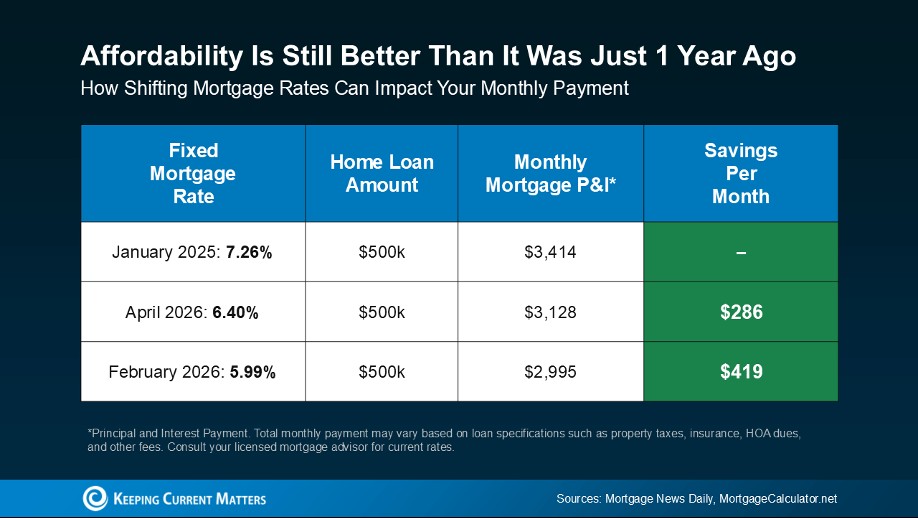
Yes, your monthly payment would’ve been a little less expensive a few weeks back, but hindsight is always 20/20. And besides, as I said earlier, it’s always the “right” time to buy when you’re ready and once again—the sooner you buy the sooner your home will be earning equity for you.
When It Comes To Rates, Expect the Unexpected
Mortgage rates are going to continue to move around in the weeks or months ahead as new information and economic reports come out.
However, try to remember you can’t control global events or where rates go next month (or even next week).
But…you CAN control how you prepare and if you do that it becomes less about the headlines, and more about your individual situation.
And buyers who do decide to move forward now can find ways to make it work.
For example, you can explore options like adjustable-rate-mortgages (ARMs) which are popular now to help get a lower rate upfront. That may or may not be right for you, but it highlights that fact that there are strategies that can help you move, even now.
What Matters Most is Having a Plan
Once we sit down and see what you want, need and can afford, you will have a much better vision of how to begin.
And I can also help steer you in the right direction for your individual situation when it comes to getting the best mortgage for you.
Bottom Line:
Even though there is some uncertainty, that doesn’t mean you are out of options. It simply means you have not yet met with me to explore ALL of the options that are available to help make your move happen.
IS COLORADO SPRINGS EXPENSIVE?
Colorado Springs 2026-2027 relocation Guide, Colorado Springs Chamber and EDC
This is a question I get asked almost daily from prospective relocation folks and from locals as well. I’ve tried to explain it’s all relative and of course, it is, as it depends on a number of factors and most obviously to where you are making the comparison.
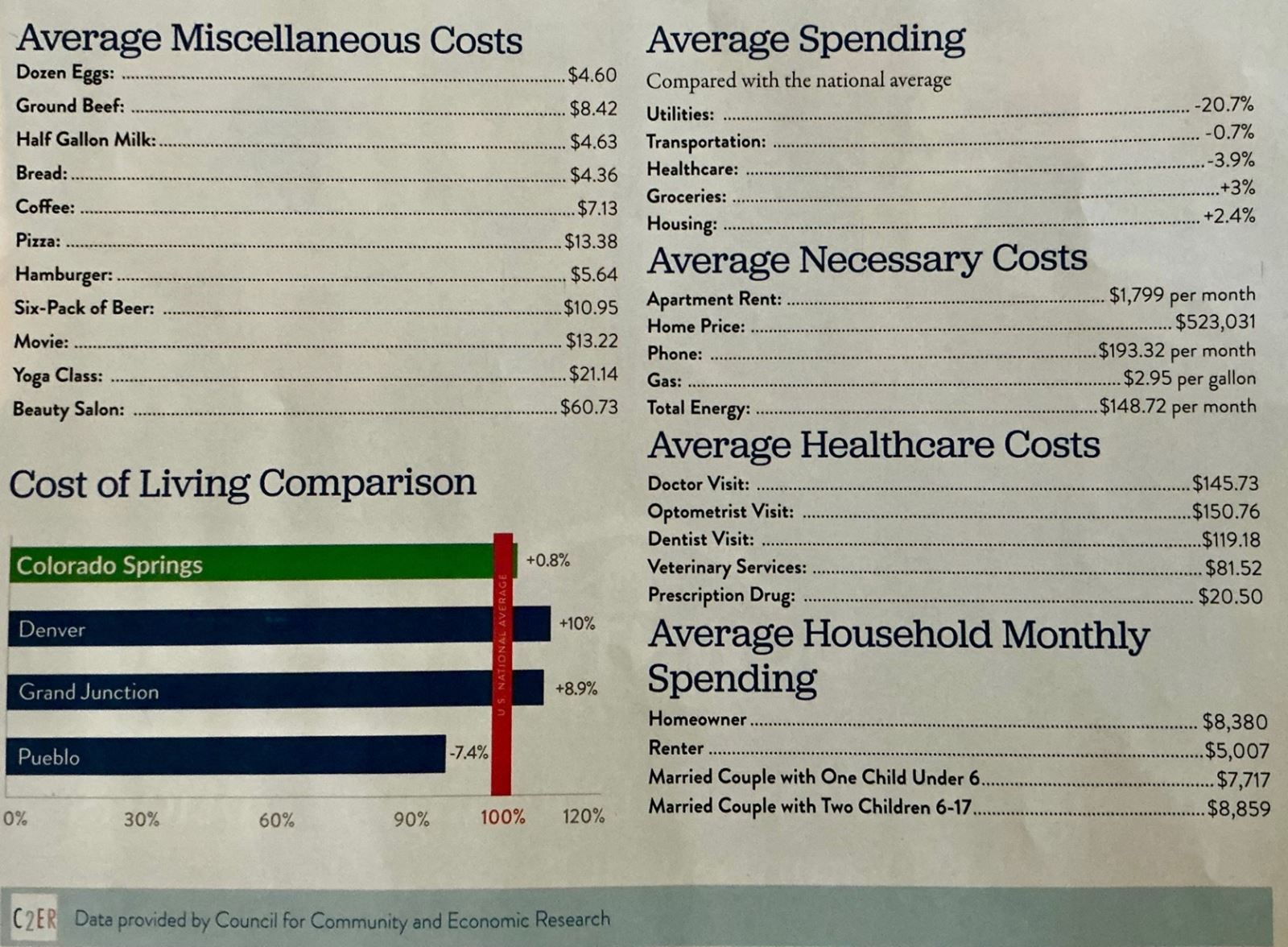
Oftentimes it is easier to try and ballpark what some of our average costs might be and recently I read an article in the Colorado Springs Chamber and EDC’s “2026 relocation Guide” that had some current cost comparisons that might interest you.
Colorado Springs has seen the overall cost of living rise in the past few years, along with most of the rest of the country, However, the good news is that our city still has a lower cost of living than most Colorado cities, including Denver and others along the popular Front Range.
I have reproduced the chart that accompanied the article showing an overview of average costs and expenses.
As you can see, our utility costs are considerably lower than the national average and in the “cost of living comparison” you will see that we are less than 1% higher than the rest of the country. In the past that could be contributed to our housing costs, but in recent years, while our home values have continued to rise at a more “normalized” rate, our housing costs have decreased and are closer to the national average as new builds and sales inventory continue to balance with demand and interest rates ease.
HOW TO GET YOUR HOME READY TO SELL
The Hartford Currant, 4.11.26
As I mentioned earlier, the spring buying and selling season is underway and if you are considering a sale, it can be somewhat daunting.
Being able to get the best first impression is critical, and most especially today when homes are taking longer to sell.
Before your home even hits the MLS there’s some work you will want to do to help give it the best first impression.
These are all things I will have gone over with you when we first discuss selling your home, but I thought it might help to give you some tips to think about even prior to that first meeting.
Curb appeal is the first thing a buyer will see either online or in person. Some things you’ll want to consider are mulching, cutting the grass, washing the house, addressing wood rot issues and cleaning up the shrubs and plants.
From there you need to address any maintenance items—even the small ones. These can be anything from chipped paint to scruff marks, burned out bulbs or ripped screens.
And make sure to address clutter. A good rule is that anything smaller than the palm of your hand should be put away.
Another thing to think about is personalization. Things such as family photos, collections or sport memorabilia should be out of sight.
Potential buyers want to envision themselves in the home and too many personalized items makes it feel like the seller’s home and not a potential home for themselves.
When it comes to storage space, you can have all the storage in the world, but if it looks packed to the brim and the doors won’t close, that won’t be a selling point because overflowing storage spaces makes it look as though there is not enough storage space. It is best to move things to the garage or other available areas to give a better look for showings.
Paint is another issue and not just chipped paint. If the home has neutral colors and it’s in good condition, there is no issue. Light neutrals are best as buyers can envision their own belongings there instead of being overwhelmed by color.
White, grey or warmer beiges are neutral enough that you aren’t having buyers walking into an alarming color like purple or turquoise.
Another important thing is to make sure all of your spaces have one purpose. A bedroom with a treadmill and a desk makes buyers question if the house is too small. It indicates there is no room for a gym and no room for an office. You don’t want to remind a buyer of anything negative in the home.
At times it is important to have a “stager” come help you think of things you might miss. One of the things a stager might do is move your furniture to highlight the home’s best features. I’ve had several of my clients use a stager for this purpose. They can also help with furnishing an empty home that’s for sale as it can make the space more inviting for the buyer.
Since many showings are in the evening or on a gloomy day, good lighting is essential to showcase the home.
You don’t need to update your kitchen or bathrooms before putting your home on the market unless you are doing it for yourself. Small adjustments can make a big impact like changing out the laminate countertops or updating the backsplash instead of doing a whole kitchen overall. It won’t look dated and won’t create a huge financial impact either.
Overall, you will want to help potential buyers envision themselves in your home and doing a little bit of prep work before putting it on the market will help sell the home in a timelier manner.