
HARRY'S BI-WEEKLY UPDATE 3.24.26
March 24, 2026
HARRY’S BI-WEEKLY UPDATE
A Current Look at the Colorado Springs Residential real estate Market
As part of my “Special Brand of Customer Service”, it is my desire to share current Residential real estate issues that will help to make you a more successful and profitable Buyer and Seller.

THE STATE OF “RESIDENTIAL real estate” CERTAINLY KEEPS ME ON MY TOES
Just after I wrote about mortgage rates being the lowest in years, boom…they rise to their highest level in three months last week!
It’s crazy times we live in today and, good or bad, when wars or other catastrophes occur almost anywhere in the entire world, our cost of goods and services change almost simultaneously. Sometimes I truly miss the days when the world was smaller (information wise) and many things were more predictable.
But so much for reminiscing. I learned long ago that we must play the cards we’re dealt and that includes the residential real estate market.
Quite honestly, as I’ve mentioned before, when I purchased my first home the FHA interest rate was 8.5% and my wife, Carol had a 12% VA loan on her first home. So compared to that, today’s 6.22% is relatively cheap.
Unfortunately, many of us still remember the 2% and 3% rates of the early 2020’s and compare today’s rate to that and are waiting for those rates to return. Well, folks, those rates were not the norm, and we are not likely to see them again soon, if ever.
Another thing to remember is that along with those rates came a shortage of homes for sale, multiple offers, many over listing price, and decisions that had to be made oftentimes without ever seeing the home and without an inspection. I can recall the total stress those days caused both my clients and me.
As you’ve seen from the statistics I send monthly, the one constant is that home values are continuing to climb and that’s not likely to change.
How does that affect you if you are looking to sell and trade up, move to a new neighborhood or buy for the first time or for investment purposes?
If you’ve been waiting, NOW is the time to start gathering information.
There are several factors to consider if you are wanting to sell and trade up or move elsewhere. To begin with, if you’ve been in your home a considerable amount of time it’s likely you have more equity than you might imagine and that can help provide a larger down payment on the new home, thus keeping your payments lower than you might expect.
Another thing to consider is the many mortgage options available.
Adjustable-rate loans (ARMs) are making a big comeback as a way to cut the cost of buying a home in the short term. While these types of loans faded from popularity when the 30-year fixed-rate loans were so low, borrowers turning to ARMs are betting they can refinance before their fixed-rate ends, typically after five, seven or 10 years.
For example, a prospective homeowner might be drawn by a 7-year ARM with a 5.5% rate, which would give them immediate savings compared with a traditional mortgage with a 6%+ fixed rate.
And ideally, they could refinance into a lower fixed-rate loan before the seven-year period ends.
What’s important to note is that ARMs are less risky than they once were. The 2008 crisis showed the danger of rates surging after short teaser periods, but regulations since then have meant ARMs now have longer initial fixed periods, providing a bigger buffer before monthly payments jump. What once was a product geared toward subprime borrowers is now more often used by affluent borrowers.
Another thing to remember is that we are now in a Buyer’s Market. What that means is that sellers are more likely to offer concessions that help with the price for the buyer. And, of course, with increased listings that we are seeing as we head into the spring buying and selling season, buyers have more choices as well as more time to find exactly what they want.
Personally, I have had more calls from clients wanting to get back in the market and are tired of waiting. I’ve seen activity start to pick up sooner than normal this time of year and I believe that bodes better for our market than possibly for some other areas of the country.
If you are wanting to enter the market you need to be prepared to know exactly what you want, need, and can afford PRIOR to beginning the search. And that includes how you wish to finance your new home.
That’s where I come into the picture.
My 54 years (in April) in the local residential real estate arena, coupled with my investment banking background, give me an edge that my clients have found to be crucial in helping them and their families realize their personal real estate visions.
I can also help steer you in the right direction to discover various mortgage options that can work for your individual situation.
But you won’t know any of this until you give me a call.
If Residential real estate is among your hopes and dreams for 2026, please give me a call at 719.593.1000 or email me at Harry@HarrySalzman.com sooner than later and let me help make them come true.
The earlier you begin the process, the sooner you will be realizing those dreams for you and your family.
HOW TO PINPOINT THE “BEST TIME TO SELL” IN 2026
National Association of Realtors, 3.18.26
For higher home prices, lower competition and a faster sale, be ready to list your home during mid-April, according to a newly released report from realtor.com.
Home sellers hoping to “time the market” will likely find April 12-18 may offer the best opportunity in 2026 according to this report.
Based on an analysis of housing trends from 2018 to 2025, researchers identified this mid-April window as a “Goldilocks” moment—when prices, demand and competition align in sellers’ favor.
Sellers who list during this week could net about $26,000 more than at the start of the year, the report finds.
“After years of being squeezed by limited inventory and high rates, the 2026 housing market is starting to feel more approachable for those who have been sidelined,” says Danielle Hale, chief economist at realtor.com. “For sellers, the mid-April window represents an opportunity to enter a market that feels more within reach for buyers while benefiting from a seasonal advantage in terms of pricing and competition.”
Still, the report emphasizes that timing can vary greatly by market.
What’s So Special About April 12-18?
Across most markets analyzed, researchers found mid-April to stand out for several reasons:
- Stronger home prices: Homes listed during this window tend to command prices about 1.3% higher than the average week, which could translate into about $5,300 above annual median list prices and $26,000 more than in January.
- Faster sales: In 2025, homes listed during this week spent about 50 days on the market—10 days less than the yearly average.
- Less competition: While housing inventories have improved, the number of for-sale signs remains about 17% below pre-pandemic norms. Listing in mid-April could allow sellers to get ahead of the late-spring surge in new listings, the report notes.
- Fewer price cuts: About 19% fewer homes see price reductions during this week, based on historical trends. Strong buyer demand appearing in the early spring season could help support better asking prices, the report says.
Challenges Remain
Housing affordability is improving with moderating home prices and lower mortgage rates. But despite encouraging signs—like a recent uptick in pending home sales last month—economists urge caution.
“These conditions could reverse if higher oil prices lead to an uptick in mortgage rates,” Lawrence Yun, chief economist at the National Association of Realtors (NAR) said last week in NAR’s latest housing report.
As I alluded to earlier, the recent conflict with Iran has added to uncertainty, pushing up oil prices and raising concerns about inflation and borrowing costs.
However, economists remain hopeful for a “rebalance” in the housing market this spring, following recent years where home sales have mostly been stuck in near three-decade lows.
Realtor.com’s report notes an easing “lock in effect” as more homeowners list and higher mortgage rates—in the 6% range—now become the norm. That could help loosen inventory constraints.
The report states that the fundamentals of the housing market remain stable heading into the spring. “The housing market remains undersupplied, especially in the Northeast and Midwest, meaning sellers of well-priced, move-in ready homes are likely to find success,” says Hannah Jones, senior economic research analyst at realtor.com.
“However, in the South and West, where inventory is more abundant, sellers face softer conditions. In those metros, optimizing timing to this early spring window is even more critical to differentiate a property from the growing competition,” Jones added.
So let me add this—my favorite spring buying and selling season adage-- “the early bird gets the worm”.
In other words, if you want to take advantage of what could be the best time this year, call me sooner than later so we can get the ball rolling for you.
IF YOUR HOUSE ISN’T GETTING OFFERS, READ THIS
Keeping Current Matters, 3.11.26
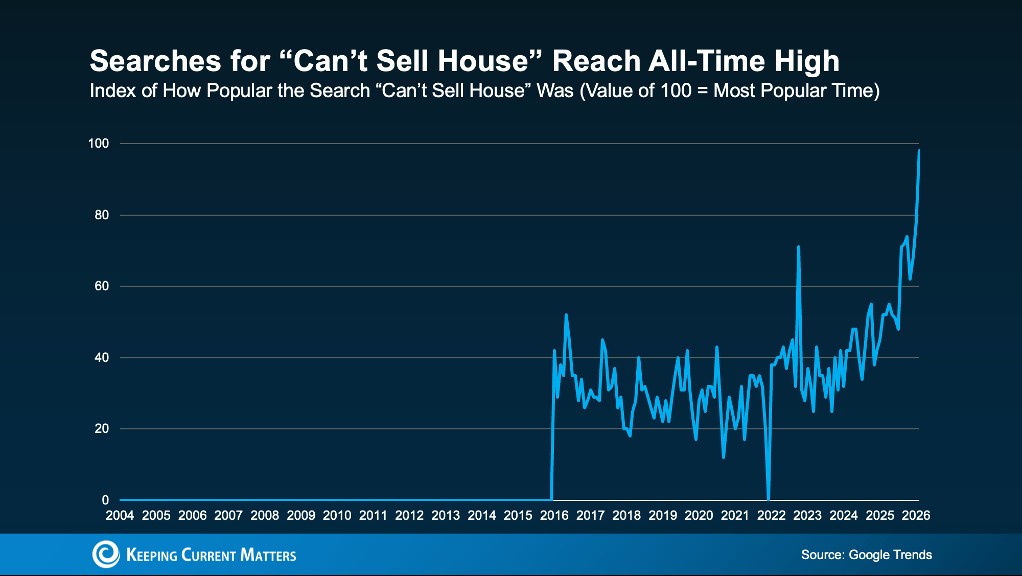
According to Google Trends, online searches for “can’t sell house” recently hit an all-time high. So, if your house has been sitting on the market without any bites, you’re not the only one. But it’s also not the end of the road.
Homes are selling every day, so you can turn this around. You just need to take another look at your approach.
If you’re feeling this pain, know this: an online search engine isn’t where you should go for your answers. It’s much better to ask me. Because a search engine doesn’t know your market or your home, but I do.
While a search or Ai platform may give you some tips on what to try, only an experienced broker like me can actually diagnosis what’s going on—and how to fix it.
A lot of things can change from when a home is originally listed and many of those can affect the time it takes to sell. I try to give you the best advise as to comparables and other things, but then the country gets involved in a war, let’s say!
While the selling of your home may not be of “national” concern, it is most definitely your concern and mine as well.
Forgetting the current state of the union, most homes that struggle to sell today are usually being held back by one (or more) of these three things.
1. Presentation: Buyers Will Compare Everything.
When inventory was tight a few years ago, buyers overlooked imperfections because they had to, or they’d lose out to another bidder but now that’s not the case.
Today’s buyers scroll through dozens of listings in just minutes. They compare condition, updates, lighting, finishes, layout and more—all side by side .If your home feels dated, cluttered or in need of repairs, buyers will notice and it’ll knock your house right off their list of contenders.
That doesn’t mean you need a full renovation. But it does mean first impressions matter again. To compete today you need curb appeal. Clean spaces, neutral colors, professional photos. If there are obvious repairs or too many outdated features it could be what’s holding you back.
2. Pricing: If the Price Isn’t Compelling, It’s Not Selling.
Maybe this is the hardest one to hear, but what your neighbor sold their house for a few years ago isn’t necessarily the same price you’ll get today.
As Selma Hepp, chief economist at Cotality, says, “For sellers, the days of pricing aggressively and expecting instant offers are largely over. Homes that are well-priced and well-presented will still sell, but pricing discipline matters more than it did during the boom years.”
Buyers are budget-conscious right now. If your home is priced based on outdated expectations instead of current demand, buyers may still look at your house online…but they likely won’t write an offer. Or they’ll make an offer that you think is too low,
Pricing too high for the market is one of the top things sellers miss the mark on today. And those who aren’t willing to meet the market where it is or entertain offers may often feel stuck.
I work diligently with my clients to try and come up with a realistic selling price but once again…unforeseen variables can at times throw a wrench in the mix and sellers might need to rethink pricing if they want a sale sooner than later.
3. Access: If Buyers Can’t See It, They Can’t Buy It
I know this sounds obvious but limited showing availability can kill your momentum. If your house isn’t easy to see because you’re restricting showings to evenings only, no weekend, or requiring a 24-hour notice, you’re cutting your buyer pool down by more than you might realize.
In a market where buyers have more options like they do today, the last thing you want to do is give them a reason to skip your house. Availability matters because if no one sees it, no one buys it.
Don’t Let Search Engine Results Decide Your Next Step
When a home isn’t selling it’s tempting to spiral and wonder if it’s the market or if something is wrong with your house. Instead of going online, here’s what to do.
Sit down with me and ask me once again:
- What are buyers looking for in today’s market?
- What feedback are we getting from showings?
- Why do you think my house hasn’t sold yet?
It’s likely I have already answered these questions and shared any feedback I’ve received in order to help you sell your home, but I thought it important to share that if you’re disappointed that your home is not selling as quickly as you might like you can see you are not alone,
I’m hopeful that when the current world interruptions settle down the traditional spring buying and selling season will get into full swing and we will see sales pick up sooner than later. Until then, if you’re waiting impatiently, please know that you’re not alone and I will do my part as diligently as ever to showcase your home for sale.
Any questions, please give me a call.
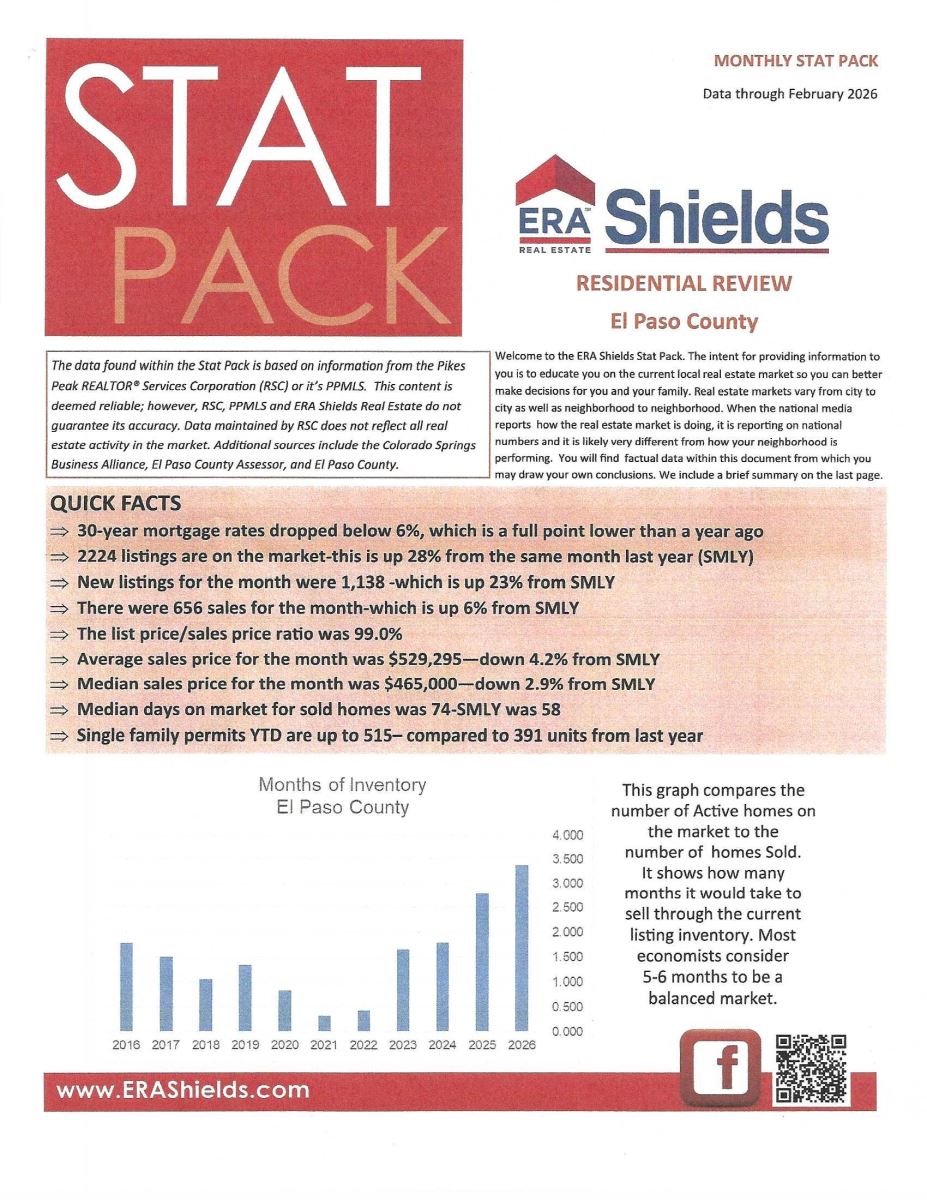
ERA SHIELDS STAT PACK
Data through February 2026, ERA Shields
Here is the newest data from my company’s monthly “Stat Pack” that can better help you understand the local buying and selling reality. I have reproduced the first page, and you can click here to get the 5-page report in its entirety.